
Consulting
How to Start a Consulting Business: The Operator's Playbook for Your First 90 Days
May 12, 2026 · Adam Fineberg


You're sitting on 15 years of expertise that companies pay $400 an hour for, and you're still trading it for a salary, a 3% annual bump, and a manager who needs your slide deck by Friday. You've thought about going independent for two years. Maybe three. This article is the playbook I wish someone had handed me before I started Jackson Square Company — a step-by-step sequence for going from "I'm thinking about it" to "I have signed contracts" in 90 days, without quitting blind, without spending six months on a logo, and without any of the manifestation-and-vision-board nonsense that fills most consulting blogs.
By the end, you'll know exactly what to do this week, what contract clauses protect you when (not if) a client tries to scope-creep you, and which marketing activities actually produce revenue versus the ones that just feel productive.
Let's get to work.
Why Right Now Is Statistically the Best Window in a Decade
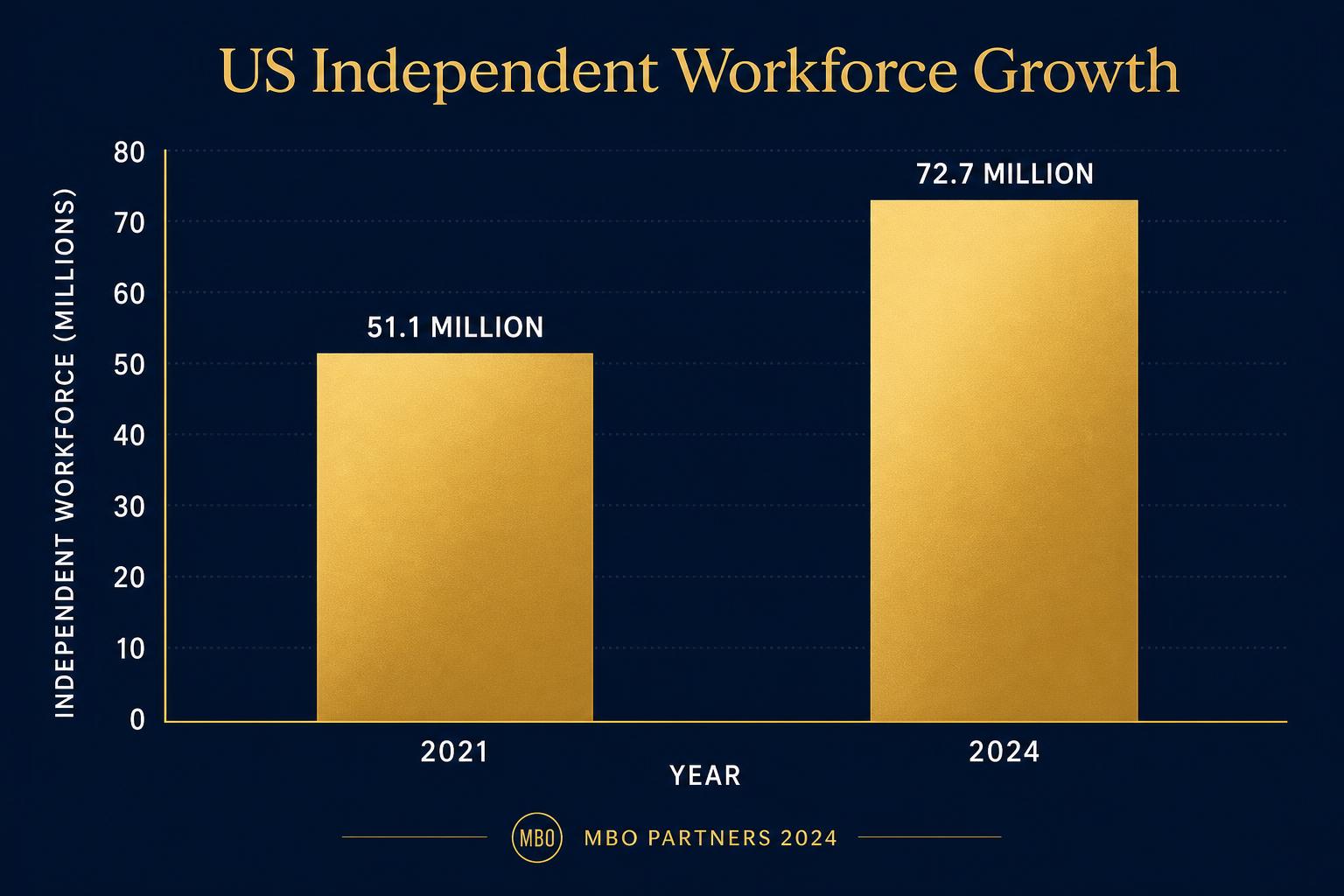
The independent workforce isn't a trend — it's the new shape of professional services. According to MBO Partners' 2024 State of Independence report, 72.7 million Americans worked independently in 2024, up from 51.1 million in 2021. Inside that group, the highest growth segment is "high earners" — independent workers making $100,000 or more — which grew to 5 million people.
What this means in practice: enterprise buyers are now structurally comfortable hiring fractional, project-based, and consulting talent. The procurement objection of a decade ago ("we only work with firms") has largely collapsed at companies under 5,000 employees. SOWs that used to require a Big Four logo now go to solo operators with a relevant case study.
The implication for you is simple. The market has expanded faster than the supply of credible operators willing to actually pitch for the work. If you have a decade of in-house expertise in a specific function — RevOps, supply chain, FP&A, HR transformation, product marketing, IT infrastructure, enterprise risk — there is a buyer right now who would rather pay you $15,000 for a 6-week engagement than hire a full-time person they can't afford and don't yet need.
The window is open. Most of your peers will spend it building a website.
Foundation Work to Do Before You File a Single Piece of Paperwork
Here is the most expensive mistake I see new consultants make: they form an LLC, build a website, print business cards, and order a $400 logo before they've talked to a single potential buyer. Six months later they have a beautiful brand and zero revenue.
Reverse the order.
Before you spend a dollar on entity formation, do three things. First, define your niche with painful specificity. "Marketing consultant" is not a business. "I help Series B SaaS companies fix their demand gen attribution" is a business. The narrower the niche, the easier the sale, the higher the rate. I tell every coaching client: if you can't finish the sentence "I help [specific buyer] solve [specific problem] so they can [specific outcome]" in under 20 words, you don't have a positioning statement yet.
Second, validate that real buyers will pay for it. Not survey them. Not ask them theoretically. Validate with what I call the 3-Conversation Validation Method (more on this framework below).
Third, calculate your runway honestly. Take your monthly personal burn rate, multiply by 9, and that's the cash cushion you want before going full-time. If you have $80,000 in expenses per year, you want roughly $60,000 in liquid savings before you give notice. Less than that and you'll make desperate pricing decisions that will haunt you for two years.
Here's the contrarian take: you do not need to quit your job to start. You need to do the foundation work nights and weekends for 60 days, sign your first one or two paid pilot engagements while still employed (assuming your contract permits it — check first), and only then give notice. Most "I quit to follow my dream" stories end in a return to W-2 work within 18 months.
How to Become a Consultant: The Operational Setup Checklist
Once you have one validated buyer signal — a real conversation with a real prospect who said "send me a proposal" — then you set up the business. Not before.
Here's the minimum viable operational stack and roughly what it costs:
Entity formation. A single-member LLC in your home state, filed yourself through the Secretary of State website, runs $50 to $500 depending on the state. California is $800/year just for the franchise tax. Delaware is popular but unnecessary for most solo consultants — file where you live. Skip the LegalZoom upsells.
EIN. Free from the IRS website. Takes 10 minutes. Do not pay anyone for this.
Business bank account. Mercury, Relay, or your local credit union. Free to open. This is non-negotiable — commingling funds is the fastest way to lose your LLC's liability protection.
Professional liability insurance (E&O). Hiscox or Thimble for solo consultants, typically $400 to $900 per year for $1M in coverage. Many enterprise clients require it as a contract precondition. Get it before you need it.
Accounting software. QuickBooks Online ($30/month) or Xero. Hire a bookkeeper for 4 hours a month at around $200 to keep it clean. Do not do your own books past month three.
Tax setup. Make a quarterly estimated tax appointment with a CPA who works with service businesses. The single biggest financial shock new consultants face is owing $30,000 in self-employment tax in April. Pay quarterly. Set aside 30% of every invoice in a separate savings account from day one.
That's the entire operational stack. Total first-year cost: under $3,000. Anyone selling you a $5,000 "consulting business in a box" course is selling you what's freely available on the IRS and SBA websites.
Pricing and Offer Construction: The Math That Sets Your Ceiling
Most new consultants price by taking their old salary, dividing by 2,000 hours, and adding 30%. That math is wrong, and it will keep you broke.
The right math: you are not selling 2,000 billable hours a year. You will sell, in your first year, somewhere between 600 and 1,000 billable hours. The rest of your time goes to sales, admin, learning, and recovery. So your effective hourly rate needs to be 2 to 2.5x what you were making as an employee just to match your old comp.
Here's a worked example. If you were making $180,000 fully-loaded as an employee, your blended hourly equivalent was about $90/hour. As a consultant, your billable rate floor is $200 to $250/hour to net the same income after taxes, insurance, and unbilled time. Most senior operators should be charging $250 to $400/hour or its project equivalent.
But here's the contrarian take I push hardest: stop selling hours. Sell outcomes.
On a Kennedy Risk Group engagement, the moment we shifted the conversation from "hours of advisory time" to "a fully built ERM program with executive reporting in 90 days," the entire negotiation changed — scope tightened, decision-making sped up, and the price went up, not down. Hourly billing punishes you for getting faster and better. Project pricing rewards expertise.
Construct three offers: a small "diagnostic" engagement ($3,500 to $7,500, two to three weeks), a mid-size "implementation" engagement ($15,000 to $40,000, six to twelve weeks), and an ongoing retainer ($5,000 to $15,000/month). The diagnostic is your wedge — it lets clients try working with you at low risk. The implementation is your bread and butter. The retainer is what funds your long-term business.
Consulting Contract Template Essentials: The Clauses That Save Your Business
Here's where I see the most legal exposure and the most lost revenue. New consultants either work without a contract, work off the client's MSA (which is always written for the buyer's benefit), or download a generic consulting agreement template from a free site and ship it without reading it.
You need your own consulting contract template that you control, that you've had a lawyer review once for $500 to $1,500, and that you customize for each engagement.
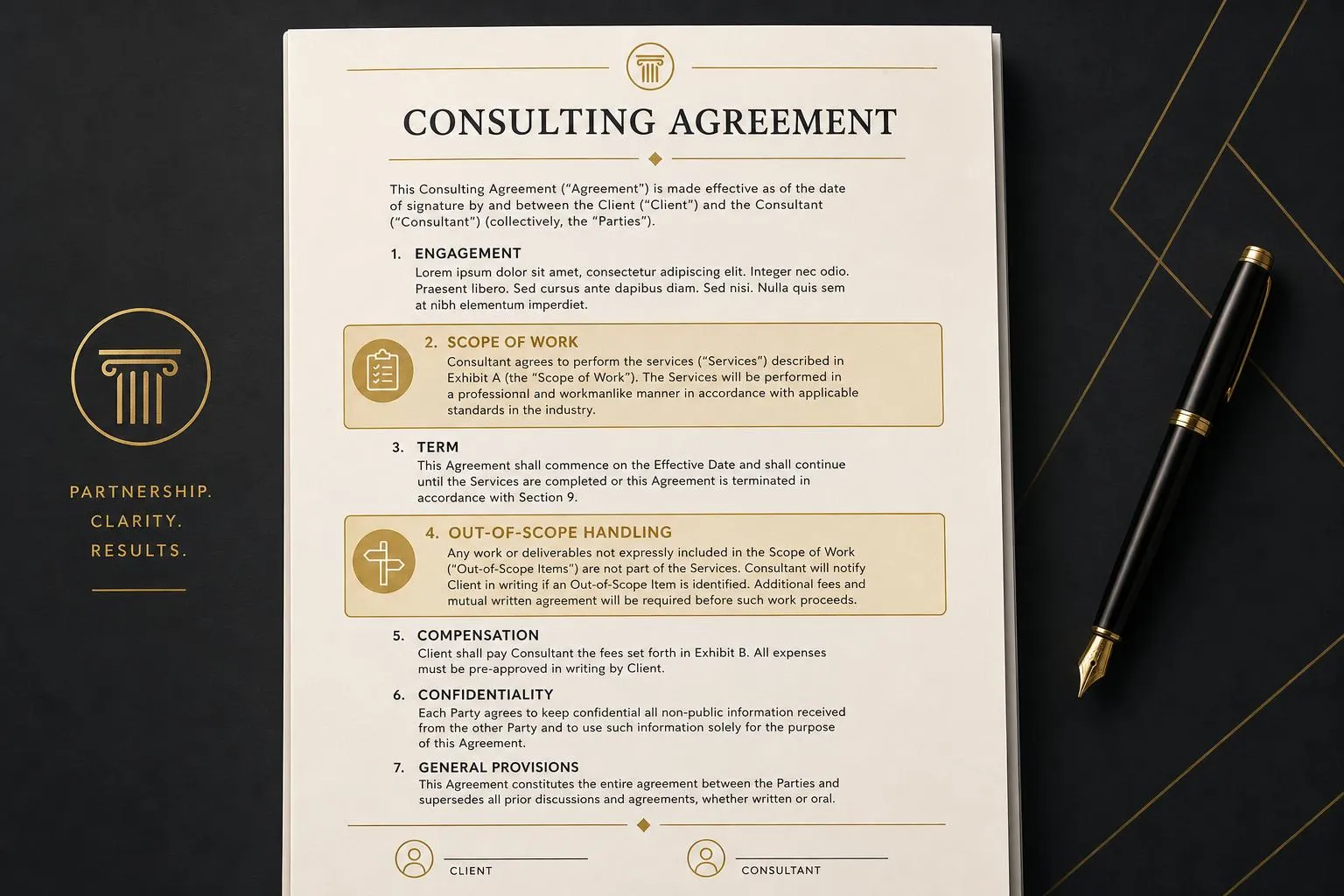
Below are the clauses that actually matter — these are the eight I treat as non-negotiable in any consulting agreement template I use myself.
1. Scope of Work, in numbered deliverables. Not "consulting services as discussed." Specific outputs, with acceptance criteria. "Deliverable 1: Written audit of current attribution model, delivered as a 15-30 page PDF, by [date]." Vague scope is how you end up working three times the hours you billed.
2. Out-of-scope handling. A single sentence that says any work beyond the listed deliverables requires a written change order at $X/hour. This clause has saved me more revenue than any other. When a client says "while you're at it, can you also…" — you point to this clause.
3. Payment terms with teeth. 50% upfront for projects under $25K, 33/33/33 milestone-based for larger. Net-15 on all invoices, not Net-30 (you set the terms, not them). Late fee of 1.5% per month. No work begins until the deposit clears. This is not aggressive — this is standard.
4. Kill fee / early termination clause. If the client terminates before completion, they pay for all work performed plus a percentage (typically 25-50%) of the remaining contract value. Without this, a client can cancel halfway through a project that took you six weeks to sell.
5. Intellectual property assignment. Spell out who owns what. Frameworks, methodologies, and pre-existing materials remain yours. Custom deliverables created specifically for the client transfer to them upon final payment. The "upon final payment" language is critical — it gives you leverage if invoices go unpaid.
6. Limitation of liability. Cap your liability at the fees paid under the contract. Without this, a single bad outcome on a $20,000 engagement can theoretically expose you to millions in damages.
7. Mutual non-disparagement and confidentiality. Standard NDA language plus a clause preventing either side from publicly trashing the other. Cheap insurance against a bad-fit engagement.
8. Independent contractor status. Explicit language that you are an independent contractor, not an employee, responsible for your own taxes, benefits, and tools. This protects both sides on misclassification risk, which the IRS and several state agencies are increasingly aggressive about.
A real lawyer-drafted consulting contract template tailored to your service runs $1,500 to $3,000 once. You will use it for every client for years. It is the single highest-ROI legal expense you will make.
Do not use a generic consulting agreement template you found on Google without having a lawyer in your state review it. The $500 you save will cost you $50,000 the first time it gets tested.
Marketing Infrastructure: The Bare Minimum That Actually Generates Leads
Here's the contrarian take that loses me followers every time I post it: in your first 90 days, do not build a website. Do not hire a brand designer. Do not start a podcast.
Build the smallest possible marketing footprint that lets a referred prospect verify you're real, then spend 90% of your effort on direct outreach.
The minimum viable marketing stack:
A one-page site. Carrd ($19/year) or a single Squarespace page. Headline that names your buyer and outcome. Three bullet points on what you do. Two or three case study summaries (anonymized if needed). Photo. Email. Contact form link. That's it. Total build time: one weekend.
A LinkedIn profile rebuilt as a sales asset, not a resume. Your headline should not be "Consultant at [Your Firm]." It should name your buyer and outcome: "Helping Series B SaaS CFOs cut burn 20% without firing the wrong people." Your About section reads like a sales letter, not a chronological work history. Featured section pinned with one case study and your contact form link.
A contact form. A simple way for prospects to reach out via the contact form. One link, in your email signature, on your LinkedIn, on your one-page site.
An email capture and CRM. For the first 50 prospects, a Google Sheet is fine. Move to HubSpot's free tier or Folk when you outgrow it. Do not buy a $300/month sales tool in your first year.
The mistake I see constantly: founders spending six weeks redesigning their site instead of having six conversations. Conversations close deals. Websites do not.
How to Start a Consulting Firm and Land Your First Five Clients
This section is the one most consulting articles skip, because it's the hardest part. Here are the four channels that actually work for new solo consultants and the script for each.
Channel 1: Your warm network, worked systematically. Make a list of 100 people who knew you in your last role and could either hire you or refer you. Senior peers, ex-managers, ex-direct-reports who've moved up, vendors and partners you worked with. Send each one a personal note — not a mass email. Script:
"Hi [Name], a quick personal update — I've left [Company] to launch an independent practice helping [buyer] solve [problem]. I'm reaching out to people who know my work to share what I'm doing. Not asking you to hire me — just asking who in your network might benefit from a no-pressure conversation about [problem]. Open to a 20-minute catch-up call this month?"
That single email, sent to 100 people over three weeks, will produce 15 to 25 conversations and one to three paying clients. Every time.
Channel 2: The "alumni audit." Pick 30 companies where ex-colleagues or ex-clients now hold buyer-level roles. Reach out individually. The trust transfer from a previous working relationship is the highest-converting lead source you will ever have.
Channel 3: LinkedIn content with a narrow promise. Post twice a week for 12 weeks. Not motivational content. Specific, tactical observations from your domain — the kind of thing your buyer reads and thinks "this person knows my problem." After 12 weeks of consistent posting on a narrow topic, inbound DMs start arriving. This is a slow channel. Start it on day one, but don't expect revenue from it for 90 days.
Channel 4: Strategic partnerships with adjacent providers. Identify five firms that sell to your exact buyer but don't compete with you. A fractional CFO firm wants to refer to a great RevOps consultant. A management consultancy wants to refer to a great technical implementer. Build three to five of these referral relationships and one or two will produce consistent leads.
Notice what is not on this list: cold email blasts, paid ads, SEO, podcast tours. All of those can work eventually. None of them produce revenue in your first 90 days.
The Discovery Call Framework That Closes Without Pressure
Most new consultants treat discovery calls as job interviews where the prospect is the hiring manager. Wrong frame. A discovery call is a mutual qualification conversation where you are deciding whether to take them on as a client.
Here's the structure I use and teach. 30 minutes, four phases:
Minutes 0-5: Frame the call. "Thanks for the time. The way I run these is — I'll spend the first 20 minutes asking about your situation, then the last 10 we'll either talk about how I might help, or I'll point you to someone better suited. Either is a good outcome. Sound fair?"
Minutes 5-20: Diagnose. Three questions, each with follow-ups. "Walk me through what's happening today." "What have you already tried?" "If we fast-forward six months and this is solved, what's different about your business?" Take notes. Ask one follow-up for every initial answer. Do not pitch. Do not solve. Diagnose.
Minutes 20-25: Decide out loud. "Here's what I'm hearing. [Reflect back the problem in their words.] Is that right?" Then either: "I think this is something I can help with — here's roughly how I'd approach it." Or: "Honestly, this sounds more like [different specialty] — I can introduce you to two people who do exactly this."
Minutes 25-30: Next step. If it's a fit: "I'll send a written proposal with two options by [day]." Never close on the call. Never quote a price live. Send a written proposal within 48 hours, with a hard expiration date 14 days out.
That's the entire framework. Run it the same way every time.
The 90-Day Consulting Sprint: My Original Framework for Your First Three Months
Here's the framework I built for my coaching clients — the same one I'd run if I were starting a new practice tomorrow. I call it the 90-Day Consulting Sprint, and it has five components in fixed sequence:
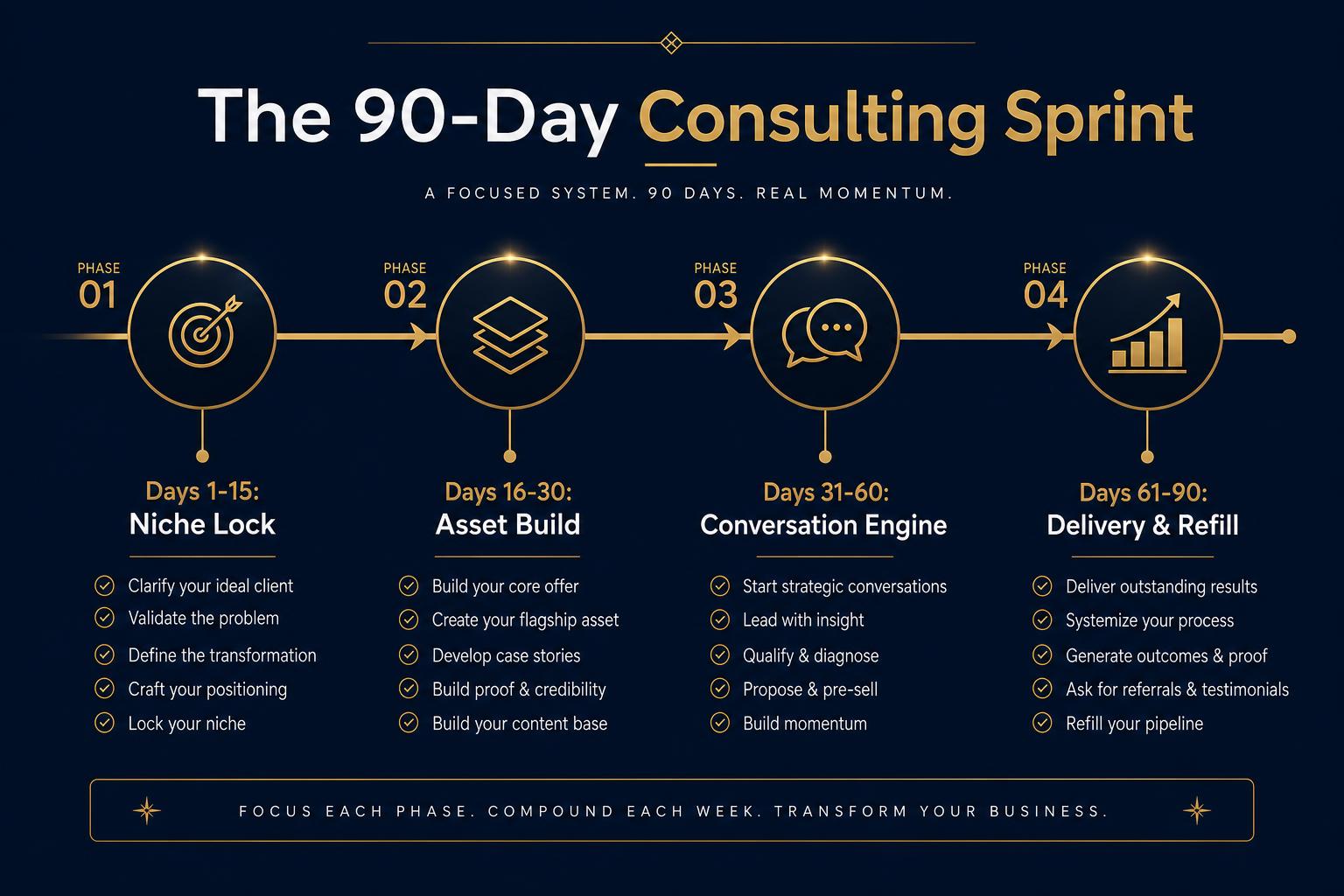
Days 1-15 — Niche Lock. One week of customer discovery interviews (eight to twelve conversations with potential buyers, no selling) to validate the niche statement. End of week two: a written, dated positioning document you commit to for at least 12 months.
Days 16-30 — Asset Build. One-page site live. LinkedIn rebuilt. Lawyer-reviewed contract finalized. LLC filed. Bank account open. Insurance bound. Pricing documented. This is the only window where you're allowed to spend significant time on infrastructure. After day 30, infrastructure work is procrastination.
Days 31-60 — Conversation Engine. 100 personalized outreach messages. 25 to 40 discovery calls. Two LinkedIn posts per week. Goal: signed first paid engagement by day 60. Not a verbal commitment. Signed contract, deposit cleared.
Days 61-90 — Delivery and Refill. Deliver the first engagement at a level that produces a written case study and one referral. Simultaneously, keep the conversation engine running — do not pause sales activity to deliver. By day 90: one to three paid clients, one referral pipeline, and a documented case study you can use for the next 12 months of marketing.
The 3-Conversation Validation Method I mentioned earlier sits inside Day 1-15: every potential niche must survive three real conversations with three different real buyers before you commit to it. If you can't get three buyers to take a 30-minute call about the problem, the niche isn't real.
That's the entire sprint. Five phases, 90 days, repeatable annually.
Common Mistakes That Sink New Consulting Firms
A short, prose-form list of the recurring failures I see in my coaching practice.
The most common is over-investing in identity and under-investing in distribution. Logo, brand, website, business cards, LLC name agonized over for months. Zero conversations with buyers. These businesses die quietly in month nine.
Second: pricing from fear instead of value. Charging $125/hour because you're "just starting out" anchors you to a rate you'll spend three years trying to escape. Your buyer doesn't know you're new. Price like you've been doing this for a decade — because you have, just inside a corporate wrapper.
Third: working without a contract or working off the client's contract. I have watched a six-figure engagement evaporate because the consultant accepted the client's MSA without reading the termination-for-convenience clause that let them walk after 30 days. Always your paper, always.
Fourth: treating delivery and sales as sequential. New consultants land a client, stop selling for six weeks while they deliver, finish the engagement, and then panic when there's nothing in the pipeline. Sales activity never stops. Even at 100% utilization. Especially at 100% utilization.
Fifth: building the firm structure before you need it. Hiring a subcontractor, building a team, registering a brand other than your own name in year one. Stay solo, stay lean, stay fast. The decision to build a firm is a year-two decision, not a year-one decision.
Frequently Asked Questions
How much does it cost to start a consulting business?
Realistic floor: $2,500 to $5,000 in the first year for entity formation, insurance, basic software, and a lawyer-reviewed contract. Add $60,000 to $90,000 in personal runway if you're going full-time. Anyone telling you it costs more is selling you something. Anyone telling you it costs less is leaving out runway.
Do I need an LLC to start consulting?
Legally, no — you can operate as a sole proprietor. Practically, yes. An LLC provides liability protection, makes you look more credible to enterprise buyers, and separates business and personal taxes. File one in week two. It costs $50 to $500 depending on your state.
How long does it take to make money as a consultant?
With focused effort using the 90-Day Consulting Sprint above, your first paid engagement should land in days 45 to 75. Replacing your full corporate income typically takes 9 to 18 months. Anyone promising six figures in 90 days is selling you a course, not a methodology.
What's the difference between a consulting business and a consulting firm?
"Consulting business" usually refers to a solo practice — one person, project-based revenue, no employees. "Consulting firm" implies multiple consultants, a partner or associate model, and infrastructure (delivery teams, sales support). Most successful firms started as solo practices that grew. Don't try to start as a firm. Start as a business that could become a firm in year three.
Can I start a consulting business while employed?
In most cases, yes — but read your employment agreement first, particularly any non-compete, moonlighting, or IP-assignment clauses. Many corporate contracts allow side work that doesn't compete directly with your employer. Some don't. Talk to an employment lawyer for one hour ($300 to $500) before you take a single dollar from a client while still on payroll.
What's the best legal structure for a one-person consulting business?
A single-member LLC taxed as a sole proprietorship for the first year, with an S-Corp election once you're consistently netting over $80,000 to $100,000. The S-Corp election can save $5,000 to $15,000 a year in self-employment tax once you're at scale. Talk to a CPA — don't make this decision from a Reddit thread.
What's the biggest predictor of success in a new consulting practice?
Not credentials, not website, not network size. The single biggest predictor I see is how many sales conversations the founder has per week in months one through six. Consultants who hit 10+ discovery calls per week land clients. Consultants who hit 2 do not. It is that mechanical.
Your Next Step
If you've read this far, you are not someone who needs more information. You're someone who needs a decision and a deadline.
Pick one weekend in the next 30 days. Block it. Do the niche-lock work. Rebuild your LinkedIn. Write your 100-person warm list. Get the contract drafted. That's the entire on-ramp to learning how to start a consulting business in a way that actually produces revenue, not just activity.
If you want to compress that timeline and avoid the mistakes I've watched dozens of senior operators make in their first year, I work with a small number of new and transitioning consultants each quarter through one-on-one coaching. We move fast: positioning, pricing, contract, pipeline, and your first signed engagement, in 90 days.
You have 15 to 20 years of expertise. The only question left is whether you're going to keep renting it to one company or start selling it to many.