
Consulting
Building Your Brand: Consultant Website Examples and a Newsletter That Converts
July 15, 2026 · Adam Fineberg


Your website and your newsletter should work together so leads keep flowing—even when you're heads-down on client work.
You landed a dream client last month, and this month your pipeline is a ghost town. If that whiplash feels familiar, the problem usually isn't your talent—it's that your brand goes quiet the moment you stop hustling. This guide walks you through consultant website examples that encourage contact-form inquiries and a consulting newsletter system that keeps prospects warm while you sleep. You'll get practical steps for turning a plain "services" page into a lead machine, plus honest tips on project management for consultants and how to start a consulting business without spinning your wheels.
Here's the good news about timing. According to the U.S. Bureau of Labor Statistics, employment of management analysts is projected to grow 9 percent from 2024 to 2034, much faster than the average for all occupations. Demand is rising. Your job is to make sure buyers find you first.
What Makes a Consultant Website Convert Instead of Just Sit There
A converting consultant website answers three questions in under ten seconds: who you help, what problem you solve, and what to do next. Most sites fail because they lead with a resume instead of a result. Visitors don't care that you have fifteen years of experience. They care whether you can fix the exact headache keeping them up at night.
Think about a hypothetical scenario. A CFO at a mid-size logistics firm is bleeding cash on a bloated software stack. She Googles a fix, lands on your homepage, and sees a headline that says "Consulting Solutions for Modern Businesses." She bounces. Now imagine she reads "I help logistics teams cut software spend by 20% in 90 days." She books a call. Same expertise, completely different outcome. Specificity sells.
The Non-Negotiable Pages Every Consultant Website Needs
You don't need twenty pages. You need a handful that each do one job well. Here's the short list I'd build first:
- A homepage with a clear promise, one primary call to action, and social proof near the top.
- A services page that frames offers around outcomes, not activities.
- A results or consulting case studies page that proves you deliver.
- An about page that builds trust with your story and credentials.
- A contact page with a form so prospects can reach out directly.
Consultant Website Examples: Three Approaches That Work
Not every consultant should build the same site. Your model shapes your layout. Here's how three common approaches compare so you can pick the one that fits your business.
| Website Style | Best For | Homepage Focus | Primary Call to Action |
|---|---|---|---|
| Authority Site | Speakers and thought leaders | Personal brand, media, and big ideas | Reach out via the contact form |
| Productized Service Site | Solo consultants with a fixed offer | One clear package and price | Buy or inquire via the contact form |
| Boutique Firm Site | Small teams and multi-service firms | Range of services and client logos | Request a proposal |
Notice that each style still points to a single next step. The fastest way to kill conversions is to offer five competing buttons. Pick the one action that matters most and make it impossible to miss.
Consulting Case Studies: Your Most Persuasive Sales Asset
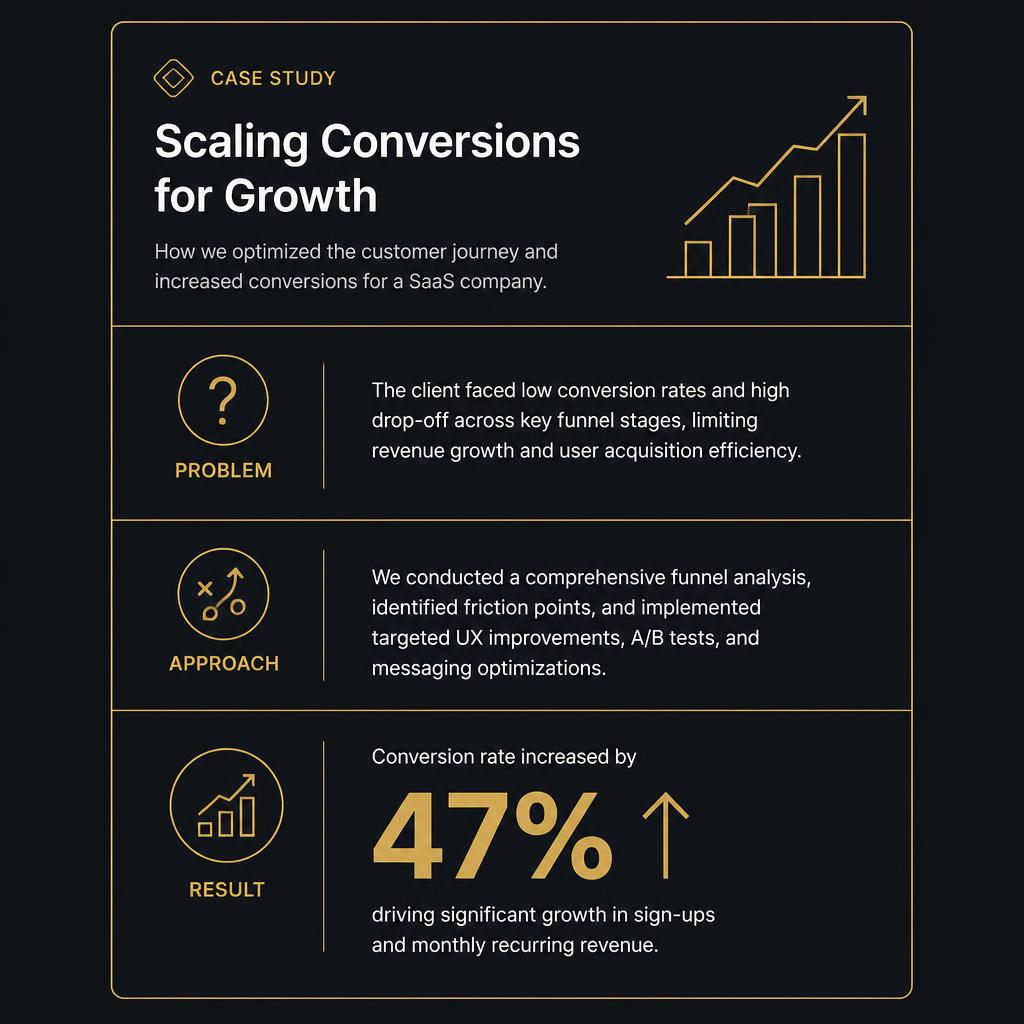
Consulting case studies convert because they let a prospect picture their own win before spending a dollar. A strong case study follows a simple arc: the client's problem, what you did, and the measurable result. Numbers beat adjectives every time. "Increased qualified leads by 34% in one quarter" lands harder than "delivered excellent results."
Keep each case study skimmable. Use a bold headline with the outcome, three short sections, and a client quote if you have one. If you're just starting and don't have paid results yet, document a project you ran for a past employer or a discounted pilot. Frame it honestly, and let the process speak for your judgment.
A Simple Structure for Writing Consulting Case Studies
- Lead with the result. Put the biggest number or win in the title.
- Set the scene. Describe the client's situation and the stakes in two or three sentences.
- Explain your approach. Show the steps you took so readers trust your method.
- Prove the impact. Share metrics, before-and-after comparisons, or a testimonial.
- Close with a nudge. Add a line inviting readers to get the same outcome.
Building a Consulting Newsletter That Actually Converts

A consulting newsletter is the highest-leverage tool for staying top of mind between projects. Your website gets someone's attention once. Email lets you earn trust every week until they're ready to buy. And the returns are hard to argue with. Per the Data & Marketing Association (DMA), the average return on email marketing is roughly $42 for every $1 spent—one of the strongest returns of any channel.
The mistake most consultants make is treating a newsletter like a megaphone for their services. Nobody signs up to read ads. Give first. Share a lesson from a recent project, a framework you use, or a mistake you watched a client avoid. When you do pitch, it feels like a natural next step, not a cold sell.
How to Structure a Newsletter Issue for Engagement
A great consulting newsletter issue teaches one idea and asks for one action. Open with a specific story or observation, deliver a practical takeaway your reader can use today, and end with a single call to action. Keep it short enough to read in three minutes. Consistency matters more than length—a useful weekly note beats a brilliant one that shows up twice a year.
Free Newsletter Tools Versus Paid Platforms
You don't need expensive software to start. Here's how the common tiers stack up so you can match a tool to your stage.
| Tier | Typical Monthly Cost | Good For | Watch Out For |
|---|---|---|---|
| Free plan | $0 | Launching with your first few hundred subscribers | Limited automation and branding |
| Starter paid | Low double digits | Growing lists that need automation and segmentation | Costs scale as your list grows |
| Pro or business | Higher monthly fee | Advanced funnels, sales sequences, and reporting | Features you may not use yet |
Start free, prove the habit, then upgrade when segmentation or automation would clearly save you time. Buying the fanciest plan before you have subscribers is a classic way to waste money you could spend on client acquisition.
Project Management for Consultants: Protect Your Reputation
Winning the client is half the battle. Delivering cleanly is what earns referrals and repeat work—and repeat work is the quiet engine of a stable practice. Solid project management for consultants keeps scope from ballooning, deadlines from slipping, and clients from wondering what they're paying for.
You don't need a heavy system. You need clarity. Define the scope in writing before you start, break the engagement into milestones, and send a short weekly update even when there's nothing dramatic to report. That single habit turns anxious clients into confident ones. Use a simple tool to track tasks and a shared document to log decisions, so nothing lives only in your head or a buried email thread.
How to Start a Consulting Business the Lean Way
You can start a consulting business faster and cheaper than most people assume. The barrier isn't money—it's clarity on who you serve and proof you can help them. Get those two things right and a laptop, a simple website, and a scheduling link are nearly enough to open your doors.
The market rewards focus. With the number of U.S. management consultants reaching almost 840,000 in 2023, according to Bureau of Labor Statistics data cited by Statista, generalists get lost. A sharp niche is how you stand out in a crowded field. Here's a lean sequence to launch:
- Pick a niche where your experience solves a specific, expensive problem.
- Write your promise as one sentence a prospect instantly understands.
- Build a focused website using the pages listed earlier.
- Publish one or two consulting case studies to prove you deliver.
- Launch a newsletter and invite your existing network to subscribe.
- Set up light project management so your first delivery is flawless.
Frequently Asked Questions
How much does it cost to start a consulting business?
You can start a consulting business for a few hundred to a couple thousand dollars in most cases. Xero estimates a range of roughly $500 to $2,000 to cover business registration, basic tools, website hosting, and initial marketing. Costs climb only if you lease office space or hire a team. Starting from home keeps your overhead low while you build a client base.
What should a consultant website include?
A consultant website should include a clear homepage promise, a services page, a case studies or results page, an about page, and a contact page with a form. Each page needs one obvious next step. Lead with the outcome you deliver rather than your credentials, and put social proof near the top so visitors trust you before they scroll.
Do I need a newsletter if I already have a website?
Yes, because a website captures attention once while a newsletter builds trust over time. Most visitors aren't ready to hire you on their first visit. A newsletter keeps you top of mind until they are, and email consistently delivers a strong return compared to other channels. It's also something you own, unlike a social media following.
How often should a consultant send a newsletter?
Aim for a consistent schedule you can actually sustain, whether that's weekly, biweekly, or monthly. Consistency matters far more than frequency. A short, useful note that arrives reliably builds more trust than a long, polished issue that appears at random. Pick a rhythm, protect it on your calendar, and treat each issue as a chance to teach one idea.
What's the best pricing model for a new consultant?
Most consultants use one of three models: hourly, per-project, or a monthly retainer. Project-based pricing works well when the scope is clearly defined, while retainers create predictable income for ongoing work. New consultants often start hourly to learn their pace, then shift toward project or value-based pricing as they gain confidence and proof of results.
How do I get my first consulting clients?
Your first clients usually come from your existing network, not cold outreach or paid ads. Tell former colleagues, mentors, and industry contacts what you now offer. Pair that with a focused website and a newsletter so warm leads have a place to learn about you. Publishing case studies and useful content builds credibility that turns quiet contacts into paying clients.
Ready to Turn Your Brand Into a Client Machine?
Your website, your case studies, and your newsletter should work together so leads keep flowing even when you're heads-down on client work. If you want a second set of eyes on your strategy—or hands-on help scaling your consulting practice—reach out through the contact page and tell me about your project. I'll review your details and get back to you as soon as I can. Let's build a brand that books itself.