
Electronic warfare was supposed to be the cheap answer to cheap drones. Jam the radio link between pilot and drone, and the drone falls or flies home. For a while, that worked. Then fiber-optic FPV drones appeared on the battlefield in Ukraine, and the jamming equation changed overnight: a drone controlled through a physical wire has no radio link to jam.
This post explains how fiber-optic drones work, why they defeat radio-frequency jamming, what their real limitations are, and what actually stops them. It is part of our Drone Defense & Interceptors series; for background on the full defeat chain, see our plain-English guide to counter-drone defense.
How a Fiber-Optic FPV Drone Works
A conventional FPV (first-person view) drone is flown by a pilot watching a video feed transmitted over radio. That radio link — video down, control up — is the drone's lifeline and its vulnerability. Interrupt it with jamming and the pilot goes blind and the controls go dead.
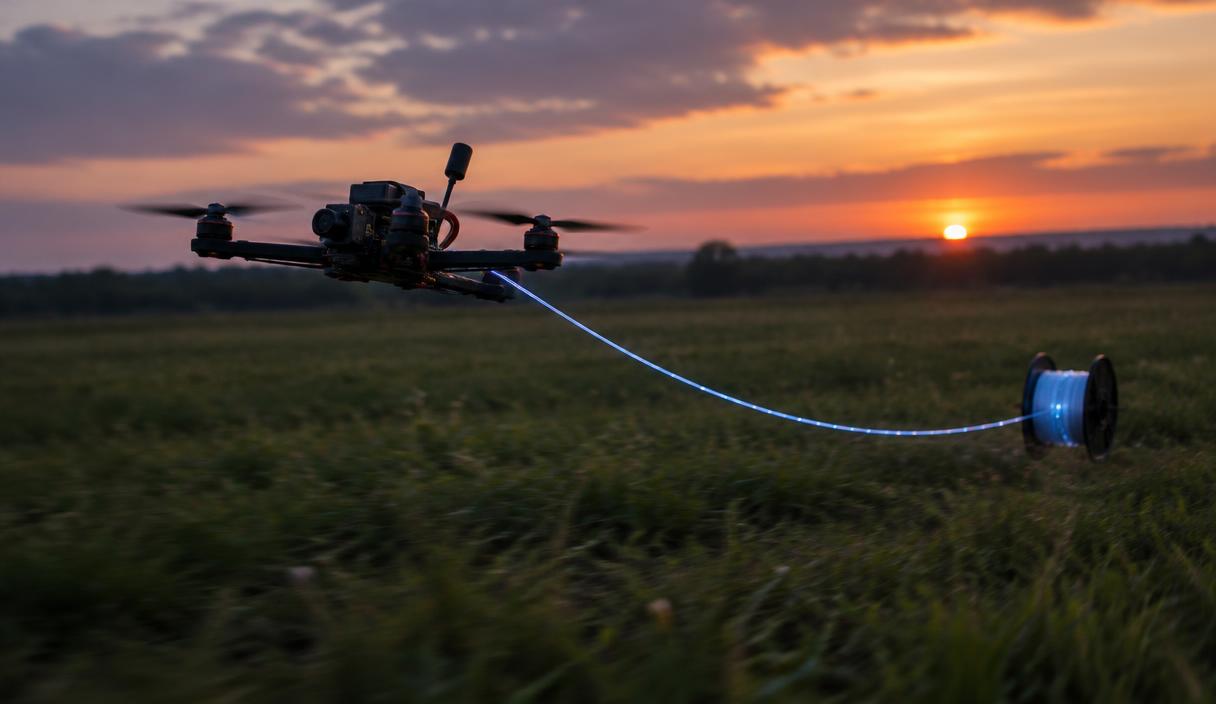
A fiber-optic FPV drone replaces that radio link with an extremely thin optical fiber that unspools as the drone flies. The spool — typically carried on the drone itself — pays out a cable that can run for kilometers. Video and control signals travel through the glass fiber as light, exactly as they do in a fiber internet connection.
The result is a drone with a high-quality, low-latency video feed and control link that is completely indifferent to radio-frequency interference. You can blanket the area with jamming energy and the drone will not notice, because it is not listening on the radio at all.
Why Jammers Do Not Work
Radio-frequency jamming works by overwhelming or confusing a receiver with noise or false signals. It is attractive as a defense because it is relatively cheap per engagement, covers an area rather than a point, and does not require hitting anything.
Fiber-optic drones sidestep the entire mechanism. There is no receiver to overwhelm. The control link is a private, physical channel — the equivalent of a landline in a world of jammed cell phones. Spoofing GPS does not help either, because FPV drones are flown by a human watching a video feed, not by satellite navigation.
This is why fiber-optic drones spread so quickly once they appeared in Ukraine: they restored reliable strike capability in environments where electronic warfare had made radio-controlled FPV drones increasingly unreliable.
The Trade-Offs: Fiber Is Not Magic
If fiber-optic drones were strictly better, every drone would use them. They have real limitations, and understanding them matters for defense.
- The cable constrains the flight. The drone is literally tethered. Aggressive maneuvering, sharp turns around obstacles, or flying over terrain that snags the fiber can break the link. Pilots must fly more conservatively.
- Weight and cost. The spool and fiber add weight and expense, reducing payload or range compared to an equivalent radio-controlled drone.
- Range is capped by the spool. The fiber's length is the drone's leash. Longer ranges are possible but add weight and cost.
- The fiber leaves traces. Laid fiber can physically mark approach routes, and spent spools are evidence.
- One pilot, one drone. Each drone needs its own pilot and its own fiber; the approach does not obviously scale to massed autonomous attack the way radio-controlled systems can.
In short, fiber-optic control trades the vulnerabilities of radio for the constraints of a physical tether. It is an adaptation, not a silver bullet — but it is an adaptation that neutralizes the cheapest layer of most counter-drone defenses.
What Actually Defeats Fiber-Optic Drones
If jamming is off the table, defense falls back to the other links in the defeat chain — detect, track, identify, defeat — with the emphasis on kinetic and physical solutions.
Detection still works. The drone is quiet on the control link, but it is still a physical object. Radar, acoustic sensors, and electro-optical/infrared cameras can all find it. In fact, detection becomes more important, because it is now the first opportunity to do anything at all.
Kinetic defeat becomes the primary option. Guns, interceptor drones, nets, and other physical effectors do not care how the target is controlled. This is one reason interest in low-cost interceptor drones has grown in parallel with fiber-optic threats: when electronic attack fails, something has to physically stop the drone, and it has to be cheap enough to use at scale.
Physical and passive measures matter. Nets, screens, and barriers around high-value targets can physically obstruct drones and their tethers. Dispersal, hardening, and concealment reduce what a successful strike can achieve.
The tether can be a weakness. The fiber is fragile. Terrain, obstacles, and even defensive countermeasures aimed at snagging or cutting tethers are being explored.
The Bigger Picture: An Adaptation Race
Fiber-optic drones are one move in a fast adaptation cycle. Radio-controlled drones were countered by jamming; jamming was countered by fiber; fiber will be countered by better detection and cheap kinetic effectors; and those will be countered by something else — greater autonomy, different tactics, new links.
The durable lesson is that no single defensive layer stays decisive for long. A counter-drone architecture built entirely on electronic warfare is now a counter-drone architecture with a hole in it. The resilient approach is layered: electronic warfare where it works, cheap kinetic effectors where it does not, strong detection underneath everything, and passive protection around the assets that matter most.
Public Examples and Context
Fiber-optic FPV drones moved from novelty to mainstream on the Ukrainian battlefield in a remarkably short time, and the open reporting on them is extensive.
They first drew wide attention when Russian units began using them in numbers — notably during fighting in the Kursk region — where Ukrainian electronic warfare had previously made radio-controlled FPV operations difficult. Ukrainian forces then adopted the same approach, and both sides now field fiber-optic variants. That symmetry is itself the lesson: any effective adaptation spreads to both sides of a conflict quickly.
Open-source footage and reporting have shown fiber-optic drones flying into buildings, under tree cover, and along roads where jamming blankets the spectrum — missions that would have been unreliable or impossible over a jammed radio link. Reporters on the ground have described discarded fiber snagging across roads and fields in heavily contested areas, a visible signature of how common the tactic has become.
The commercial drone world is watching too. The same tethered-link idea has legitimate uses — tethered drones have long been used for persistent surveillance and communications relay — so the underlying components are widely available and not easily controlled.
What This Means for Defenders
The rise of fiber-optic control changes the defender's priorities in concrete ways.
Invest in detection first. When jamming cannot break the link, the engagement starts with finding the drone. Radar optimized for small targets, acoustic sensors, and electro-optical systems — fused into one picture — become the foundation everything else depends on.
Treat kinetic effectors as the primary defeat layer, not the backup. Guns with airburst ammunition, interceptor drones, and other physical effectors work regardless of how the target is controlled. They need to be cheap enough and numerous enough to matter, because the attacker is not limited by jamming anymore.
Use the tether against the attacker. The fiber constrains how the drone can be flown. Obstacles, wires, netting, and terrain that snag or stress the cable are meaningful defensive tools, and channeling approaches through cluttered terrain raises the pilot's difficulty.
Keep electronic warfare — but in its place. Jamming still defeats the large share of drones that remain radio-controlled, and it protects against other threats. The mistake is relying on it alone.
For a real-world example of cheap drones reaching high-value targets, see what Operation Spiderweb means for US base defense.
Frequently Asked Questions
What is a fiber-optic drone?
It is a drone — usually an FPV type — controlled through a thin optical fiber that unspools from a spool as it flies, instead of a radio link. Video and control signals travel through the fiber as light, which makes the link immune to radio-frequency jamming.
Can fiber-optic drones be jammed at all?
Their control and video links cannot be jammed by conventional radio-frequency electronic warfare, because there is no radio receiver to overwhelm. They can still be detected, tracked, and destroyed by physical means, and their fiber tether imposes real flight limitations that defenders can exploit.
Are fiber-optic drones replacing radio-controlled drones?
No. They are heavier, more expensive, range-limited by the spool, and constrained in maneuvering, so both types coexist. Radio-controlled drones remain cheaper and more flexible where jamming is weak; fiber-optic drones are chosen where electronic warfare is dense. Expect both — and continued adaptation on each side.
Views are my own and based on publicly available reporting and analysis. Nothing here reflects the position of any company or organization.