
Base Defense
Operation Spiderweb: What It Means for US Base Defense
October 18, 2026 · Adam Fineberg

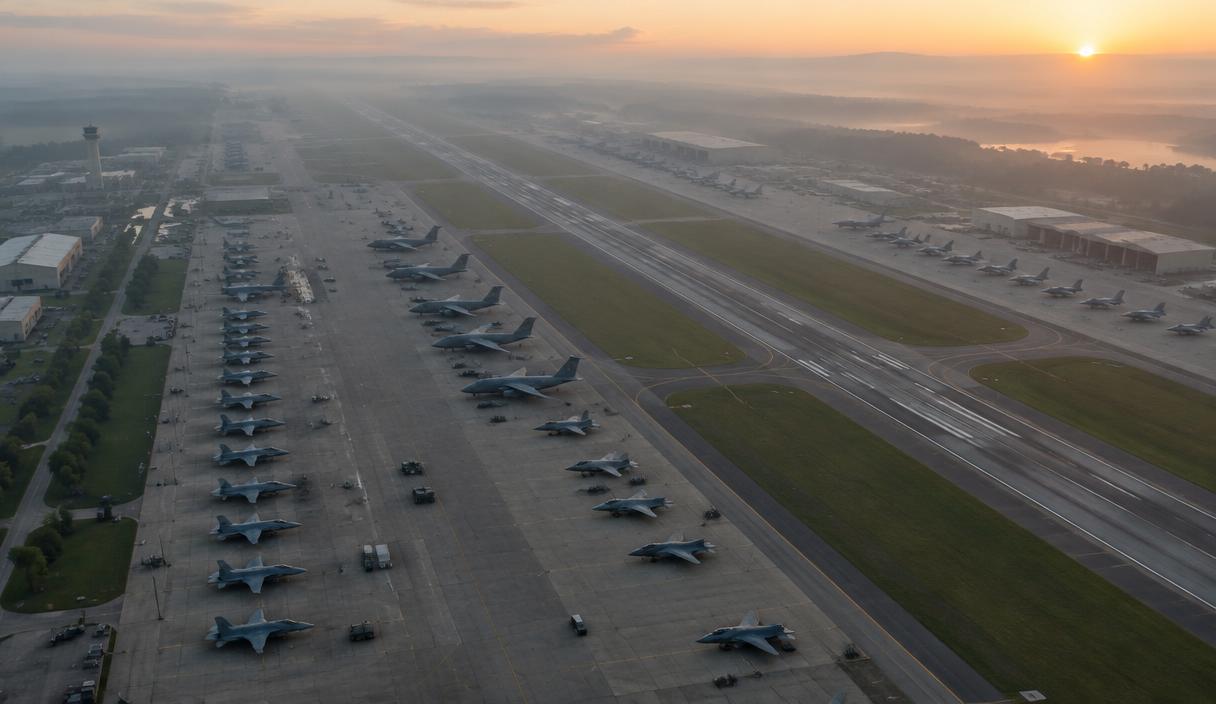
In June 2025, Ukraine's security service carried out one of the most audacious operations of the war. According to Ukrainian officials and extensive open reporting, drones smuggled deep into Russia — reportedly concealed in trucks and launched from within Russian territory — struck multiple airbases simultaneously, damaging or destroying strategic aircraft parked in the open. The operation, known as "Spiderweb," reached bases thousands of kilometers from the front line.
Whatever the precise tally of damage, the operation demonstrated something every air force in the world immediately understood: parked aircraft at rear-area bases are vulnerable to cheap drones, and distance from the front is no longer protection. This post looks at what Operation Spiderweb revealed and what it means for US base defense. It is part of our Base & Infrastructure Protection series; for the fundamentals of counter-drone defense, see our C-UAS guide.
What the Operation Demonstrated
Based on public reporting, the operation combined several elements that together defeated perimeter-based assumptions about security:
- Launch from inside the defended area. The drones were not flown across a defended border; they were reportedly transported covertly and launched close to their targets, compressing the defenders' reaction time to minutes.
- Cheap aircraft against exquisite ones. The attacking drones were small, inexpensive FPV-type systems. The targets were strategic aircraft worth tens or hundreds of millions of dollars each — assets that cannot be quickly replaced.
- Simultaneity. Multiple bases were attacked in a coordinated window, complicating any centralized response.
- Exploitation of open storage. Aircraft parked in the open presented targets that a small drone with a small warhead could meaningfully damage.
The operation echoed a longer pattern — drone attacks on airbases had been occurring for years — but its reach and coordination made it a watershed moment in public discussion of base defense.
Why This Matters for US Bases
The United States operates from bases around the world, and its aircraft — like everyone's — spend most of their lives parked. Several uncomfortable facts follow from the Spiderweb model.
The threat does not need to cross the perimeter. Small drones can be purchased commercially, transported in ordinary vehicles, and launched from outside or inside a base's fence line. Defending against an attack that begins two kilometers from the runway is a fundamentally different problem from defending against one that begins two thousand kilometers away.
The cost exchange is brutal. A few thousand dollars of drone can mission-kill an aircraft worth a hundred million dollars or more. Even a failed attack that forces aircraft to be dispersed, sheltered, or relocated imposes real costs.
Peacetime posture is the vulnerability. Bases in rear areas are organized for efficiency — aircraft parked close together, fuel and munitions in known locations, perimeters designed against people and vehicles rather than small aircraft. That posture is exactly what a drone attack exploits.
The US homeland is not exempt. If drones can be smuggled and launched near airbases abroad, the same model applies domestically. The legal and procedural questions of counter-drone authority at US installations — who may engage, under what rules, with what systems — become operationally urgent rather than theoretical.
The Layers of a Real Answer
Public discussion among defense analysts since the operation has converged on a layered approach, much of it applicable well beyond airbases.
Hardening and dispersal. The cheapest countermeasure is not a weapon at all: shelters, revetments, dispersal of aircraft, and simply not concentrating irreplaceable assets in neat rows. Hardened shelters have their own costs and politics — they have been debated for decades — but the Spiderweb operation strengthened the case considerably.
Detection close to the base. Because the launch may happen nearby, sensors need to cover the immediate surroundings, not just the horizon. Radar tuned for small drones, acoustic arrays, and electro-optical systems fused into a common picture give defenders the minutes they need.
Cheap, always-on defeat options. A base cannot answer a two-thousand-dollar drone with a million-dollar missile as a matter of routine. Guns, interceptor drones, electronic warfare (where the threat is radio-controlled — see our piece on fiber-optic drones for where it is not), and eventually directed energy provide the sustainable layer.
Counter-infiltration. The Spiderweb model depends on moving drones and operators close to the target undetected. That makes base defense partly a counterintelligence and law-enforcement problem, not only an air-defense one.
Passive protection for what cannot be moved. Fuel storage, munitions, and command facilities need their own protection, from physical screens to rapid repair plans.
The Institutional Challenge
Perhaps the hardest part is not technical. Counter-drone defense at US bases sits at the intersection of military force protection, FAA airspace rules, and legal authorities that were written before small drones existed. Engaging a drone over a US installation raises questions that engaging one over a forward base overseas does not. Exercises, clear rules of engagement, and rehearsed coordination with civil authorities are as much a part of the answer as any sensor or weapon.
The Takeaway
Operation Spiderweb did not reveal a new capability so much as it demonstrated, at scale and in public, what cheap drones plus creativity can do against unprepared rear areas. The lesson for US base defense is straightforward: assume the attack can start close, assume it will be cheap, and build layered defenses — hardening, detection, affordable effectors, and clear authorities — before the assumption is tested.
Public Examples and Context
Spiderweb was the most dramatic example of a pattern that had been building in public for years.
Drone attacks on Russian airbases — including the Engels base that hosts strategic bombers — had been reported repeatedly before June 2025, typically using longer-range one-way attack drones launched from Ukrainian territory. Spiderweb differed in method (launch from inside Russia, close to the target) rather than in concept: the vulnerability of parked aircraft to small drones was already documented.
The United States has its own warning signs. In late 2023 and 2024, US officials publicly acknowledged repeated incursions by unidentified drones over Langley Air Force Base in Virginia and other sensitive installations — events that were never fully explained publicly and that prompted visible concern from senior commanders. Whatever those drones were, the episodes showed that even premier US bases face small-drone activity they cannot easily attribute or stop.
And the commercial-drone incidents at airports — Gatwick in 2018 being the famous case, where reported drone sightings shut a major airport for days — demonstrate how little it takes for small aircraft to disrupt high-value aviation infrastructure, even with no warhead involved at all.
What This Means for Defenders
For commanders, facility managers, and policymakers, the practical implications cluster into four commitments.
Assume launch from close range. Perimeter-focused defense is necessary but not sufficient; sensors and response plans must cover the possibility that the attack begins minutes from the target, from a van, a rooftop, or a tree line.
Protect what is parked, not just what is flying. Hardened shelters, dispersal, decoys, and simple netting or screens over high-value assets are unglamorous and comparatively cheap — and they directly address the exact vulnerability Spiderweb exploited.
Field affordable, always-on effectors. The cost-curve logic applies to bases as much as to the front line: the defense has to be able to engage cheap drones every night without expending irreplaceable interceptors.
Rehearse the legal and interagency side now. In the US homeland especially, the authority to detect, track, and defeat drones involves statute, regulation, and coordination across agencies. That groundwork takes time and cannot be improvised during an incident.
Frequently Asked Questions
What was Operation Spiderweb?
It was a Ukrainian operation in June 2025 in which, according to Ukrainian officials and extensive open reporting, drones smuggled deep into Russia — reportedly concealed in trucks — were launched from within Russian territory against multiple airbases simultaneously, damaging or destroying strategic aircraft parked in the open.
Could a similar attack happen against a US base?
The underlying model — commercially available drones, covert transport, launch from close range — is not exotic, and US officials have publicly acknowledged unexplained drone incursions over sensitive US installations. That is precisely why base defense, hardening, and clear domestic counter-drone authorities have become active topics in US defense discussion.
What is the single most effective protection for parked aircraft?
There is no single fix, but the cheapest and most immediate measures are passive: hardened shelters, dispersal, and physical screens or netting. These do not require defeating the drone at all — they reduce what a successful attack can achieve — and they buy time for detection and active defenses to work.
Views are my own and based on publicly available reporting and analysis. Nothing here reflects the position of any company or organization.