
Drone Swarms
Drone Swarms Are Here: Why Defense Has to Scale Cheaply
October 18, 2026 · Adam Fineberg

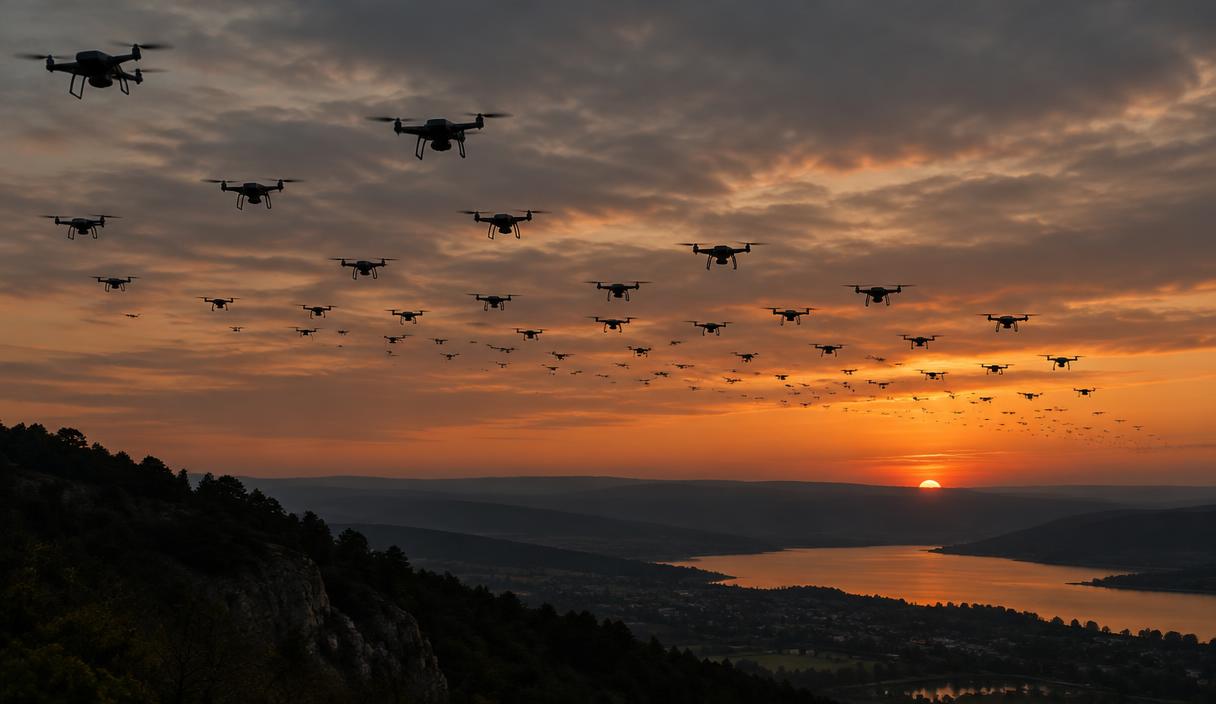
For most of aviation history, numbers were expensive. More aircraft meant more pilots, more airframes, more money. Drone swarm technology breaks that assumption. When individual aircraft cost hundreds or thousands of dollars instead of millions, an attacker can field dozens or hundreds at once — and that changes the mathematics of defense completely.
This post explains what drone swarms are, why they are hard to stop, and why the only durable answer is defense that scales as cheaply as the attack. It is part of our Swarms & Ukraine Lessons series; for the fundamentals, see our plain-English guide to counter-drone defense.
What "Swarm" Actually Means
The term gets used loosely, so it helps to separate three ideas.
First, there is the mass attack: many drones launched at the same target or region, each flying its own pre-programmed route. This requires no coordination between the drones at all — the swarm is in the numbers, not the software. Most large one-way attack drone raids to date work this way.
Second, there is the coordinated swarm: drones that share information and divide tasks — some scout, some decoy, some strike. This is harder to build but is an active area of development in several countries.
Third, there is the autonomous swarm: drones that make collective decisions in real time with minimal human input. This is the most discussed and least deployed category, though demonstrations grow more capable every year.
The important point is that even the simplest version — sheer mass — is already a serious defensive problem. The fancier versions make it worse.
Why Swarms Break Traditional Defense
Air defense has always been an engagement problem: detect a target, track it, assign a weapon, engage, assess, move to the next target. Every step takes time and consumes a resource — a missile, a burst of ammunition, a channel on a fire-control radar.
A swarm attacks every step of that chain at once:
- Saturation. If twenty drones arrive together and a defensive position can engage two at a time, eighteen get through the first window. Defenses designed for a handful of simultaneous targets are overwhelmed by arithmetic alone.
- Magazine depth. Even a defense that can engage many targets runs out of interceptors. Reloading takes time; the swarm does not wait.
- Cost. As with the Shahed-136 cost-curve problem, answering cheap drones with expensive missiles loses the economic exchange even when every shot hits.
- Decoys and noise. Cheap drones force defenders to spend real interceptors on targets worth nothing, while the drones that matter slip through in the confusion.
Lessons From Ukraine and Elsewhere
The war in Ukraine has been the largest real-world laboratory for massed drone warfare. Several patterns have emerged from public reporting.
Layering works. No single system stops massed drones; a mix of electronic warfare, guns, mobile fire teams, and interceptor drones, each handling the threats it is cheapest against, performs far better than any single exquisite system.
Detection is the bottleneck. You cannot engage what you have not found, and small drones are hard to find early. Acoustic sensors, radar tuned for small slow targets, and electro-optical systems all play a role, and fusing them matters more than any one sensor.
Defense has to be everywhere or the attack has to be predictable. Attackers choose the time and place; defenders must cover everything worth hitting. That asymmetry favors cheap offense unless the defense is also cheap enough to distribute widely.
What a Scalable Defense Looks Like
If the offense scales by being cheap, the defense must scale the same way. The directions being pursued across the counter-drone field follow logically from that:
- Cheap kinetic effectors. Interceptor drones and gun systems with smart, inexpensive ammunition bring cost per engagement down toward the cost of the attacking drone.
- Directed energy. Lasers and high-power microwaves have very low cost per shot once the system exists, and microwaves in particular can affect multiple drones at once — one of the few tools that gets better against a swarm.
- Electronic warfare at scale. Jamming and spoofing can defeat whole classes of drones cheaply — though the rise of fiber-optic-controlled and autonomous drones complicates this, as we cover in our piece on why fiber-optic drones beat jammers.
- Left-of-launch measures. Striking launch sites, production, and logistics remains the cheapest way to stop a swarm — before it is in the air.
No single layer is sufficient. The winning combination is the one that keeps the cost-exchange ratio favorable across a long campaign, not just a single night.
The Strategic Picture
Drone swarm technology democratizes mass. Capabilities that once required an air force now require a workshop and a supply chain. That does not make defense hopeless — Ukraine has shown that determined, layered, adaptive defense can blunt massed drone attacks — but it does mean the defense has to be designed for scale from the start.
The question for every military and every protected site is no longer "can we shoot down a drone?" It is "can we shoot down a hundred, tonight, tomorrow, and every night after, at a cost we can sustain?" The answer to that question will define air defense for the next decade.
Public Examples and Context
Swarm-scale drone use is no longer hypothetical, and the public examples span from battlefields to airshows.
The clearest military examples are the massed one-way attack drone raids over Ukraine, in which dozens — at times reportedly hundreds — of drones have been launched in a single night against cities and infrastructure. These are mostly "mass attack" swarms in the sense described above: saturation by numbers rather than software coordination. Even so, they have repeatedly stressed air-defense networks that were designed for far smaller raid sizes.
On the coordinated end of the spectrum, civilian drone light shows offer a benign but instructive demonstration: hundreds or thousands of drones flying precise, choreographed formations under centralized control. The same control techniques, applied to military payloads, are what defense planners worry about. Several countries have also publicly demonstrated military swarm programs — launching groups of drones from aircraft, vehicles, or tubes — showing that coordinated multi-drone operations are an active, funded area of development rather than science fiction.
Finally, the proliferation of small FPV drones in Ukraine shows swarm logic at the tactical edge: individual pilots rather than autonomy, but used in such volume that the cumulative effect on the battlefield resembles a swarm's.
What This Means for Defenders
Three practical conclusions follow for anyone responsible for protecting a site, a formation, or a city.
First, plan for the raid size, not the single drone. Exercises and architectures built around one or two intruders will fail against twenty. Engagement capacity — sensors, fire-control channels, and effectors — has to be sized for the plausible mass attack.
Second, cost per engagement is a readiness metric. A defense that wins every engagement but spends a hundred times the attacker's cost is losing the campaign. Cheap effectors are not a nice-to-have; they are what makes sustained defense possible.
Third, layering is not optional. Electronic warfare, guns, interceptor drones, and passive measures each cover the others' weaknesses. The defenses that have held up best in public reporting are the ones that were mixed, distributed, and adapted quickly as the threat changed.
For a real-world example of cheap drones reaching high-value targets, see what Operation Spiderweb means for US base defense.
Frequently Asked Questions
What is drone swarm technology?
It is the use of many drones together to achieve an effect a single drone cannot. The term covers everything from simple mass attacks — many independently programmed drones launched at once — to coordinated swarms that share information and divide tasks, and ultimately to autonomous swarms that make collective decisions with minimal human input.
Are fully autonomous drone swarms operational today?
Public evidence suggests not, at least not at scale. Most large drone raids to date use pre-programmed routes with no in-flight coordination. Coordinated and autonomous swarms have been demonstrated in tests and exercises by several countries, and the technology is advancing quickly, but the mass attack remains the dominant real-world form.
Can electronic warfare stop a drone swarm?
Sometimes, and cheaply — which is why jamming and spoofing remain core layers. But it is not a complete answer: drones with inertial or pre-programmed navigation, fiber-optic control links, or onboard autonomy can be partially or wholly indifferent to jamming. Electronic warfare works best as one layer among several, not as the whole defense.
Views are my own and based on publicly available reporting and analysis. Nothing here reflects the position of any company or organization.